
Fibreboard Panels for Furniture, Interiors and Flooring
Fibreboard reaches the market through four published application groups: furniture manufacturing, interior design, construction and wooden case packaging. Dongstar lists ISO, CE, CARB and FSC across the range and publishes thickness from 2 to 30 mm, with named uses running from cabinets, shelves and tables to wall panels, moldings, doors, floors, partitions, acoustic panels and false ceilings.

Key takeaways
- Furniture work is published around cabinets, shelves and tables, on raw MDF, MHR MDF (Green) or HDF (Black).
- Interior design covers wall panels, moldings, doors and floors, with matt, textured, glossy, embossed or magic surface treatments available.
- Construction uses the range for interior partitions, acoustic panels, false ceilings and architectural millwork, with FR MDF (Red) as the fire-retardant base board.
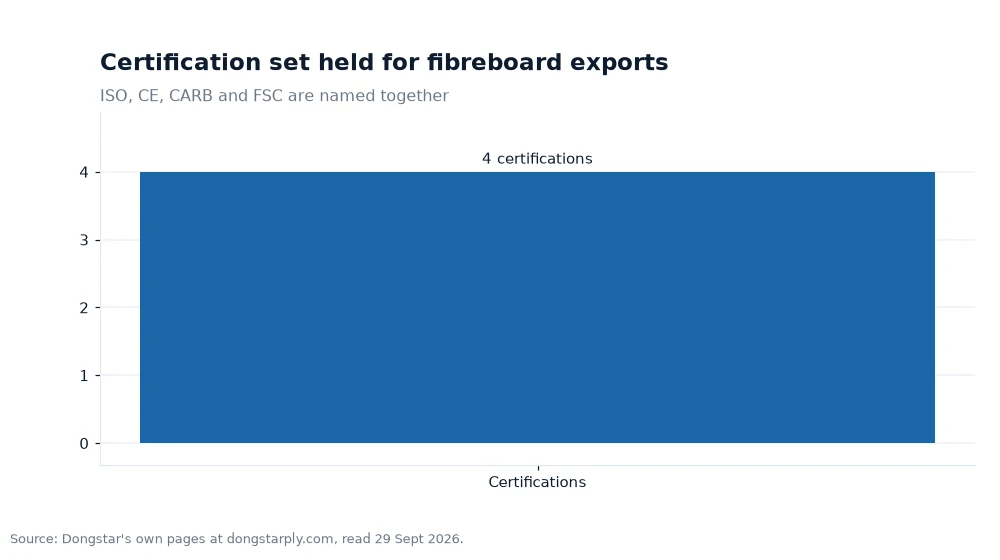
- Four certificates are named together, ISO, CE, CARB and FSC, and the structural lines add E0 or E1 formaldehyde classes on request.
Furniture manufacturing: cabinets, shelves, tables
Furniture is the largest published use of the range, and the reason is mechanical rather than decorative: fibreboard is uniform in density, so a screw, a dowel or a cam fitting behaves the same way wherever it lands on the sheet. Cabinets, shelves and tabletops can all be nested from the same board without watching for a soft core.
Board choice inside furniture is decided by service conditions rather than by looks. Raw MDF suits dry interiors; MHR MDF (Green) is published as the moisture-resistant option for kitchen and bathroom carcasses; HDF (Black) takes the higher-density role in wear surfaces and door faces. The published ladder runs from 2.7 mm upward through 3, 6, 9, 12, 15 and 18 mm, so a furniture drawing can be matched to a board that exists rather than to a nominal size invented for the job.
Interior design: wall panels, moldings, doors, floors
Interior fit-out is where the surface lists in the range start earning their keep. Wall panelling, moldings, door skins and flooring all begin as a flat board, and the published surface treatments, matt, textured, glossy, embossed and magic, plus wood-grain, solid colour, fabric and marble patterns, decide how the finished element is read at close range.
Doors and flooring make a second demand that wall panels do not: repeatability. A door is one of many identical elements in a building, and a flooring substrate has to sit flat under a wear layer. Board from one production batch keeps colour and thickness consistent across those repeats, which is why interior contracts usually order the full quantity in one release.
Construction: partitions, acoustic panels, false ceilings, millwork
In construction the range is published for interior partitions, acoustic panels, false ceilings and architectural millwork. These are interior uses where flatness and dimensional consistency matter more than impact resistance, because the panels are usually lined, painted or covered on site.
Two published boards answer the compliance questions that come with those applications. FR MDF (Red) is the fire-retardant board for spaces with a specified reaction-to-fire class, and MHR MDF (Green) is the moisture-resistant board for areas that see humidity, such as kitchens, bathrooms and service zones. Both are published across the same thickness steps, so a specification can be met without changing the family.
Crates, pallets and workshop use
Wooden case packaging is the fourth published group: crates, pallets and display racks, where the board is valued for flatness and for holding fixings rather than for its face. Display racks sit between packaging and furniture, since they are built once and then looked at for years.
DIY closes the list, and it is a larger segment than it sounds. Cutting, drilling and painting fibreboard need no specialist tooling, and the range covers the thicknesses those jobs ask for from 6 mm upward. Because the board machines cleanly and takes paint without filling, it is often the substrate chosen for a one-off built-in rather than a bespoke timber carcass.
Four certificates and what each one covers
ISO, CE, CARB and FSC are published together for the range, and they answer four different questions. CE documentation supports placing the product in a European construction context; CARB and the formaldehyde classes behind it govern interior furniture sold into North America; FSC speaks to the origin of the fibre; ISO is a management system statement rather than a product test.
Reading them as a set is what avoids a mismatch later. A buyer placing a contract in Europe needs to know how CE applies to the exact board on the order, and a buyer supplying furniture into North America needs the formaldehyde classification for the finished panel, not a general statement about the factory. The E0 or E1 classes named on the structural pages are the same kind of product-specific figure. A Medium Density Fibreboard product page that prints the certificate set beside the board makes that check a single reading rather than a round of emails.
| Application group | Published uses | Board note |
|---|---|---|
| Furniture manufacturing | Cabinets, shelves, tables | Raw MDF, MHR MDF (Green) or HDF (Black) |
| Interior design | Wall panels, moldings, doors, floors | Matt, textured, glossy, embossed, magic finishes |
| Construction | Partitions, acoustic panels, false ceilings, millwork | FR MDF (Red) for fire-retardant needs |
| Wooden case packaging | Crates, pallets, display racks | Flatness and fixing performance over finish |
Worked example: door fronts from a single sheet
A kitchen run of six door fronts at 0.6 m × 0.72 m gives 0.6 × 0.72 = 0.432 m² per door, so 6 × 0.432 = 2.592 m² of face needed (example arithmetic). One 1220 × 2440 mm sheet carries 1.22 × 2.44 = 2.98 m², so the run fits on a single sheet with 0.388 m² left over, roughly 13% of the board (example).
Double the run and the arithmetic shifts in the buyer's favour: 12 doors need 5.184 m², which is two sheets at 5.96 m², leaving 0.776 m² of offcut at the same 13%. That is the point where ordering the full quantity in one release pays twice, because it keeps the colour batch consistent and stops the leftover area being re-ordered as another sheet.
Frequently asked questions
Which fibreboard suits a bathroom cabinet?
MHR MDF (Green), the published moisture-resistant board in the range, with a melamine or PVC face and edge banding on every cut side. The face protects the panel surface while the banding protects the core, which is where moisture damage normally starts.
Is fibreboard used as a flooring substrate?
Wood flooring is named among the applications published for the range. As a substrate it sits under a separate wear layer, and the panel's own job is to stay flat and hold its thickness, which is why the published thickness steps from 6 mm upward matter more than the face.
Which certificates apply to fibreboard exports?
ISO, CE, CARB and FSC are published for the range, and E0 or E1 formaldehyde classes are named on the structural pages as available on request. Ask which of them applies to the exact board and market rather than to the factory in general.
Matching the board to the space it goes in
The faced products used in furniture and fit-out are described on the melamine-faced panel page, while the group behind the certificates and the standards work is set out in the company background. Read both before writing a specification that mixes a wear surface with a compliance requirement.
Application groups, board options and the certificate set referenced above are listed on the maker's site, as read on 29 September 2026, as applied to the chart above and were read on 29 Sept 2026[1].