
Sustainable Packaging for Perfume: Timeline and Lead Times That Hold
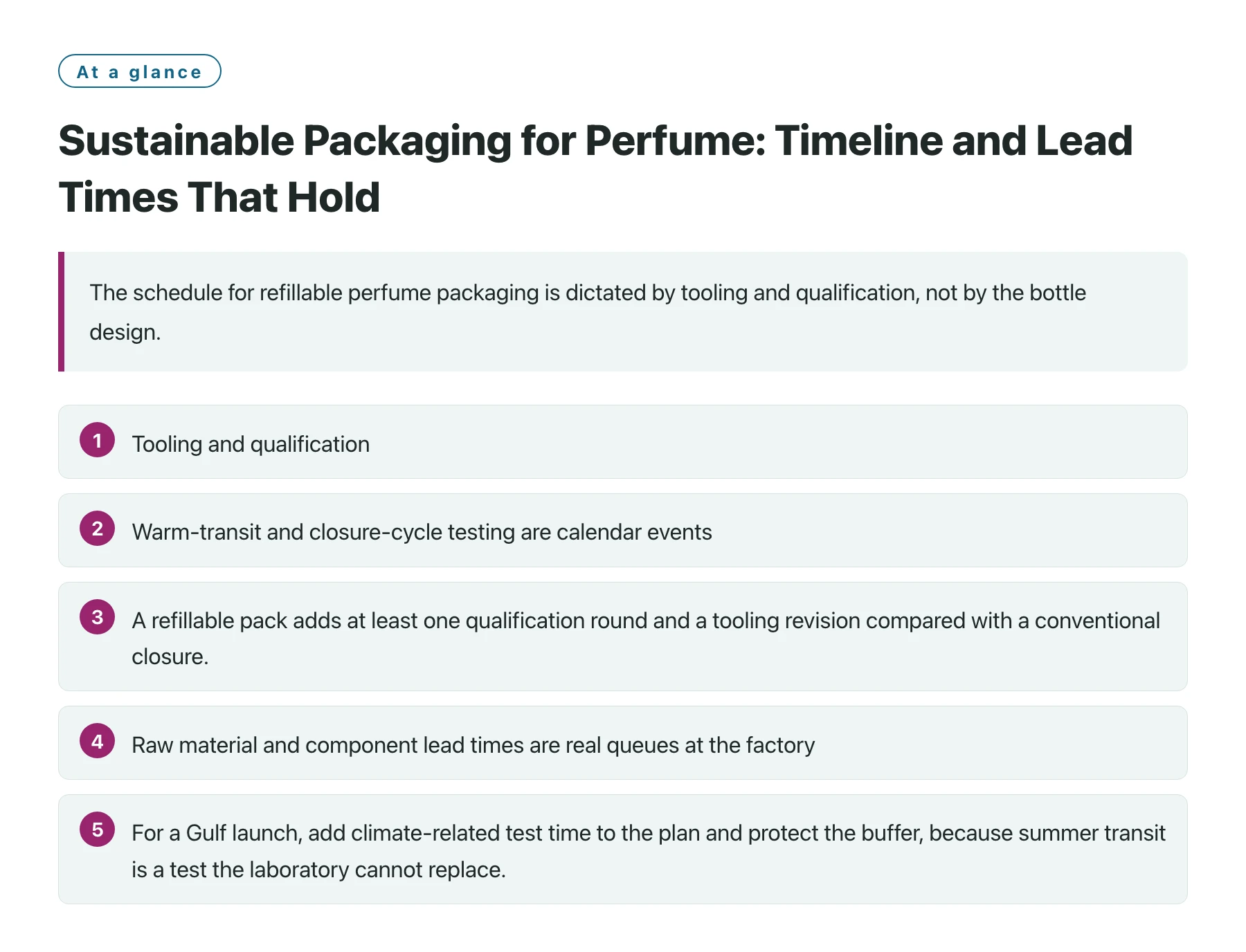
The schedule for refillable perfume packaging is dictated by tooling and qualification, not by the bottle design. Realistic planning puts tooling at the longest single block of the calendar, qualification testing and warm-transit validation after it, and the first production run only after both have passed — which means a launch date should be set backwards from the packaging lead time, not forwards from the idea. Brands that treat the packaging timeline as a guess lose a quarter; those that treat it as the project's critical path usually ship on the date they promised.
Key takeaways
- Tooling and qualification, not design, set the packaging calendar; launch dates should be set backwards from them.
- Warm-transit and closure-cycle testing are calendar events, and skipping them to hit a date costs a rework cycle later.
- A refillable pack adds at least one qualification round and a tooling revision compared with a conventional closure.
- Raw material and component lead times are real queues at the factory, and the calendar is only as good as the supplier's honest answers.
- For a Gulf launch, add climate-related test time to the plan and protect the buffer, because summer transit is a test the laboratory cannot replace.
Packaging timelines fail in predictable places: the design is approved on schedule, the tooling starts, and then the calendar falls apart somewhere between mould trials and qualification testing. The fix is not better forecasting; it is treating the timeline as a sequence of gates and refusing to let a marketing date compress a technical one.
This article is written for the project lead who has to hold a Gulf launch date together: it maps the realistic sequence, explains why refillable changes the math, and lists the lead-time questions worth asking before any tooling starts.
The timeline, in the order it runs
- Design freezeThe pack is specified and the artwork locked before tooling starts. Changes after this point reset the calendar, because moulds are cut to the frozen design.
- ToolingThe longest single block of the calendar. Moulds are cut, trialled and corrected, and the first physical samples arrive only at the end of this stage.
- QualificationThe engineering tests: closure cycles, fill and seal behaviour, and warm-transit validation. This is the stage most brands compress, and the one that most often bites back.
- Component and material orderingBottles, closures and refills are produced after qualification, and their production slots at the factory are real queues that cannot be rented with a rush fee.
- Production and releaseFilling, decoration, release testing and the documentation pack. Finished goods appear after this block, and the calendar should hold a buffer for the file itself.
- Shipping and shelfTransit, customs and the retailer's own quality check. A warm-climate summer route deserves its own review, because heat finds every closure the lab approved at room temperature.
Why refillable changes the math
A conventional pack has one qualification round: the closure is a known component and the test list is short. A refillable pack adds the refill's own geometry, a second seal, and a durability question — how many open-close cycles does everything survive — which is another test round whether the design is new or reused. The honest planning consequence is that the refillable version of the same bottle costs the calendar an extra qualification block, on top of the tooling revision for the closure seat.
Material choices add schedule pressure of their own. Where packaging and packaging-waste rules apply, recyclability and design requirements are part of the specification from the drawing board, not a question for the label stage [1]. Industry guidance on packaging design treats recyclability as a property of the material plus the collection system that receives it, which is why a claim should be verified before the artwork goes to print rather than after [2]. Custom scent development and custom packaging usually move on the same calendar, so the scheduling discipline of a custom fragrance development partner custom fragrance development partner is part of this same critical path.
When you are settling the calendar, verify the assumptions behind the plan: a manufacturer that publishes its scope and process, as on www.xuelei.com www.xuelei.com, makes the six lead-time answers easier to sanity-check before tooling starts.
Buffer rule: put the buffer at the end of qualification, not at the end of the calendar. A buffer placed after production is a wish; a buffer placed before production is a plan.
The lead-time questions to ask
Ask the factory five questions before the design is frozen: how long the tooling stage runs, what the qualification scope includes and how long it takes, whether component production slots are already committed, what happens to the calendar when a qualification fails, and how the lead times vary by season. In a warm-weather market, add the sixth: which transport profile the closure is actually validated for. Those six answers define the calendar more honestly than any planning document.
The frame for comparing suppliers' answers — what capacity and lead-time claims a factory should be able to support — is covered in detail by production capacity and lead times production capacity and lead times. The principle is the same for packaging as for the fragrance itself: a claim without a process behind it is a guess with a date attached.
Finally, favour manufacturers that publish their own scope and process rather than asking for it in every conversation, because an open process is usually a documented one.
Sources
- European Commission: Packaging Waste and the PPWR —— EU rules on packaging and packaging waste, including the Packaging and Packaging Waste Regulation requirements on recyclability and design.
- Sustainable Packaging Coalition —— A membership organisation working on more sustainable packaging design, publishing material and recyclability guidance.
Frequently asked questions
How long does refillable packaging take to develop and tool?
The tooling stage is the longest single block of the calendar, and the refillable version adds a qualification round on top of a conventional pack. There is no universal number — the honest answer comes from the supplier's stated tooling duration and qualification scope, which is why those two questions come first.
What is the most common cause of packaging launch delays?
Compressing or skipping qualification to protect a marketing date, then discovering a closure or seal problem in production or transit. A rework cycle always costs more calendar time than the skipped test would have.
Can qualification testing be skipped to hit a launch date?
It can be, and the industry does it regularly — then pays for it in rework, returns and reputational damage. For a warm-climate market, warm-transit validation in particular is not optional, because heat exposes seals the laboratory never saw.
What is the difference in timeline between conventional and refillable packaging?
The refillable version adds at least one qualification round and a tooling revision for the closure seat and refill geometry. Everything else — design freeze, material ordering, production — behaves the same way.
How much buffer should a packaging timeline include?
Enough to absorb one failed qualification and one component-slot shift, placed before production rather than after it. The exact size depends on the supplier's answers, but the position of the buffer matters more than its size.